
Fire Safety Audit Assessment in Bangladesh: A Complete Guide
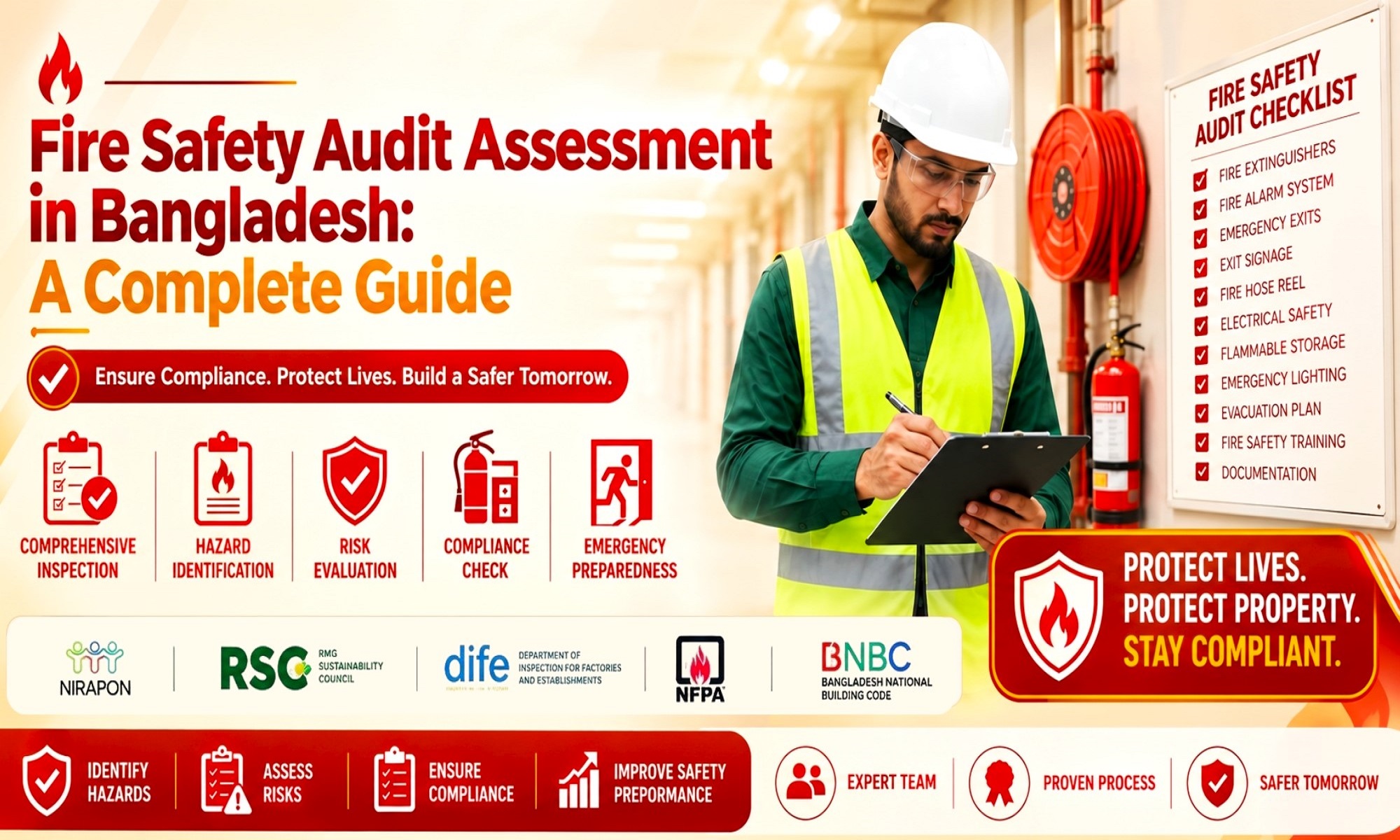
The Best Fire Safety Audit Assessment in Bangladesh should not be treated simply as a checklist exercise. A meaningful assessment combines physical inspection, fire-risk identification, review of fire-protection systems, emergency-egress evaluation, documentation review, regulatory comparison and practical corrective-action planning.
Electrical faults, overloaded circuits, combustible materials, blocked exits, inadequate fire protection systems, poor housekeeping, unsafe storage and insufficient emergency preparedness can all increase the consequences of a fire incident.
For this reason, a professional Fire Safety Audit Assessment is an important part of an organization's overall fire-protection and risk-management program.
In Bangladesh, fire-safety evaluation may involve several regulatory and technical references depending on the building, occupancy, business activity and applicable authority.
What Is a Fire Safety Audit Assessment?
A Fire Safety Audit Assessment is a systematic examination of a building, facility, workplace or industrial premises to identify fire hazards and evaluate whether existing fire-prevention, fire-detection, firefighting, evacuation and emergency-response arrangements are suitable for the facility.
A professional Fire Safety audit normally considers both the physical condition of the premises and the management systems supporting fire safety.
The assessment can examine:
- Building fire protection
- Fire hazards
- Electrical safety
- Fire alarm systems
- Fire detection systems
- Fire extinguishers
- Fire hydrant systems
- Automatic sprinkler systems
- Fire pumps
- Emergency exits
- Exit routes
- Fire doors
- Emergency lighting
- Exit signage
- Fire-rated construction
- Flammable-material storage
- Emergency response
- Fire drills
- Evacuation arrangements
- Fire-safety documentation
- Maintenance and inspection records
- Training and awareness
The objective is to identify weaknesses before an emergency occurs and provide management with a practical roadmap for improvement.
Why Is Fire Safety Audit Important in Bangladesh?
Bangladesh has a wide range of industrial, commercial, residential and institutional buildings with different occupancy patterns and fire risks. A factory manufacturing combustible products, a warehouse storing materials, a shopping complex, a hospital and a residential building do not have identical fire-safety requirements.
A proper audit therefore needs to consider the actual use and characteristics of the facility.
The Bangladesh National Building Code 2020 includes requirements related to fire protection and requires buildings to comply with provisions concerning fire detection, alarm, evacuation and extinguishment systems. For industrial occupancy, BNBC 2020 also addresses access, exits and emergency escape arrangements.
A fire-safety audit can help an organization:
- Identify potential ignition sources
- Discover unsafe conditions
- Detect deficiencies in fire-protection systems
- Review emergency escape routes
- Evaluate firefighting preparedness
- Improve fire-risk management
- Prioritize corrective actions
- Strengthen emergency response
- Maintain better safety documentation
- Prepare for applicable regulatory inspections
Fire Safety Bangladesh Laws, Codes and Regulatory References
There is no single checklist that can correctly describe every building in Bangladesh. Requirements can vary according to occupancy, building characteristics, industrial processes, hazardous materials, location and applicable authority.
However, several important legal and technical references form the foundation of fire-safety compliance.
1. Fire Prevention and Extinction Act, 2003
The Fire Prevention and Extinction Act 2003 is one of the principal pieces of legislation governing fire prevention and firefighting matters in Bangladesh.
A fire-safety assessment should therefore consider the legal obligations relevant to the facility rather than relying only on an internal company checklist.
2. Prevention & Extinction Rules, 2014
The Prevention and Extinction Rules 2014 provide another important regulatory reference.
This is particularly important when preparing a current compliance program because organizations should verify the latest applicable requirements rather than relying on old copies of legislation or outdated audit templates.
3. BNBC 2020
The Bangladesh National Building Code (BNBC) 2020 is a major reference for building safety in Bangladesh.
The Building Construction Act provides government authority to establish the Bangladesh National Building Code, including provisions concerning:
- General building requirements
- Fire protection
- Building materials
- Structural design
- Construction practices and safety
- Building services
- Alteration and change of use of existing buildings
4. Fire Service & Civil Defense Requirements
Services including:
- Fire safety training
- Fire drills
- Risk assessment / survey
As of 2026, Bangladesh has introduced an e-Fire License system. The official portal states that e-Fire License issuance began on 1 May 2026, with implementation being phased across types of fire licenses during FY 2026–2027. It also states that previously issued licenses are being brought into the e-Fire License system through a reassessment process rather than the previous renewal approach.
This makes current regulatory verification particularly important for businesses preparing or maintaining fire-safety documentation.
5. RSC Requirements for Applicable RMG Factories
For RMG factories covered by the RMG Sustainability Council (RSC), additional technical requirements and inspection criteria may apply.
RSC's published Technical Guidelines include sections covering:
- Fire protection construction
- Fire protection systems
- Means of egress
- Building materials
- Building services
- Electrical safety
- Existing buildings
- Human-element programs
RSC also publishes technical remediation guidance covering topics such as fire-safety testing and commissioning, fire-rated steel construction, fire-protection systems and third-party certification of fire-safety systems.
Therefore, an RMG facility should not assume that a general commercial-building checklist is sufficient for its applicable RSC obligations.
What Does a Professional Fire Safety Audit Check?
A comprehensive fire safety audit should look beyond fire extinguishers.
A. Building & Occupancy Assessment
The auditor may review:
- Building use
- Occupancy classification
- Number of floors
- Floor area
- Occupant load
- Building access
- Site access
- Emergency vehicle access
- High-risk areas
- Hazardous areas
- Storage arrangements
- Process areas
- Utility areas
- Generator rooms
- Electrical rooms
- Boiler areas
- Kitchen areas
- Chemical-storage areas
The assessment should recognize that different occupancies can require different fire-protection approaches.
B. Fire Hazard Identification
The first step in a useful fire-risk assessment is identifying possible sources of fire.
Potential hazards may include:
- Electrical faults
- Overloaded circuits
- Damaged cables
- Poor cable management
- Hot work
- Welding
- Cutting operations
- Combustible dust
- Flammable liquids
- Gas systems
- Cooking equipment
- Boilers
- Generators
- Batteries
- Machinery
- Smoking
- Improper chemical storage
- Excessive combustible materials
- Unsafe waste accumulation
The auditor should consider both the likelihood of ignition and the potential consequences.
C. Electrical Fire Safety
Electrical systems are a major area of concern in many industrial and commercial facilities.
A fire safety audit may review:
- Main electrical panels
- Distribution boards
- Cable condition
- Cable routing
- Circuit protection
- Earthing
- Electrical room housekeeping
- Panel clearance
- Overloading
- Temporary wiring
- Generator installation
- Transformer areas
- Battery rooms
- Cable penetrations
- Electrical maintenance records
- Thermographic inspection records where applicable
For facilities covered by RSC, electrical safety is separately addressed through RSC's electrical-safety inspection program.
D. Fire Alarm & Detection System
The fire alarm system should be evaluated for suitability, condition and functionality.
The safety audit checklist may include:
- Fire alarm control panel
- Smoke detectors
- Heat detectors
- Manual call points
- Sounders
- Visual alarm devices
- Alarm zones
- Loop configuration
- Battery backup
- Fault indications
- Detector condition
- Panel accessibility
- System testing
- Maintenance records
- Alarm audibility
- Interface with other systems
BNBC 2020 specifically includes fire detection and alarm provisions within its fire-safety requirements.
E. Fire Extinguishers
The audit may examine:
- Correct extinguisher type
- Quantity
- Location
- Accessibility
- Mounting
- Identification
- Pressure condition
- Physical damage
- Inspection status
- Service records
- Expiry/service dates
- Compatibility with the hazard
Examples of fire risks that may require different extinguishing approaches include ordinary combustibles, flammable liquids and energized electrical equipment.
F. Fire Hydrant System
For facilities requiring hydrant protection, the audit may evaluate:
- Fire water source
- Fire water tank
- Fire pump arrangement
- Jockey pump
- Main fire pump
- Diesel pump where applicable
- Pump controller
- Hydrant valves
- Hose reels
- Landing valves
- Fire hoses
- Hose cabinets
- Fire department connections
- Pressure condition
- Test arrangements
- Pump-room condition
- Maintenance records
The system should be evaluated according to the requirements applicable to the particular building and its fire-protection design.
G. Automatic Sprinkler System
Where sprinkler protection is required or installed, an assessment may cover:
- Sprinkler coverage
- Sprinkler head condition
- Obstructions
- Control valves
- Alarm valves
- Water supply
- Fire pumps
- Pressure
- Test arrangements
- Pipe condition
- Supports
- Drain/test facilities
- Maintenance
- Inspection records
A sprinkler system should not be judged only by whether sprinkler heads are physically installed. Water supply, control equipment, system configuration, maintenance and functionality are equally important.
H. Emergency Exit & Means of Egress
Safe evacuation is one of the most important components of fire protection.
The audit should examine:
- Number of exits
- Exit accessibility
- Exit width
- Travel paths
- Exit doors
- Stairways
- Exit enclosures
- Emergency lighting
- Exit signs
- Obstructions
- Locked exits
- Storage in escape routes
- Door swing
- Fire doors
- Evacuation routes
- Assembly arrangements
RSC's fire-safety manual describes means of egress as a continuous and unobstructed route from a building location to a public way and distinguishes exit access, exit and exit discharge.
For example, RSC guidance contains specific criteria for certain buildings concerning occupant loads, number of exits, door swing and travel distances. These values are not universal to every Bangladesh building; the applicable occupancy and standard must be confirmed for the facility being assessed.
I. Fire Doors & Compartmentation
Fire doors and fire-rated construction can limit the spread of fire and smoke.
The audit may review:
- Fire-door rating
- Door condition
- Self-closing devices
- Door gaps
- Hardware
- Exit enclosure protection
- Fire-rated walls
- Fire-rated floors
- Shaft protection
- Service penetrations
- Cable penetrations
- Pipe penetrations
- Fire stopping
- Unprotected openings
RSC technical guidance specifically addresses fire-protection construction and exit-enclosure issues for applicable factories.
J. Emergency Lighting & Exit Signage
During a fire, normal electrical power may fail or visibility may be reduced by smoke.
The assessment can review:
- Emergency lights
- Battery backup
- Exit signs
- Directional signs
- Stairway illumination
- Escape-route visibility
- Testing arrangements
Emergency signage should be visible, understandable and appropriately positioned along the evacuation route.
K. Fire Pump & Fire Water Supply
A fire-protection system is only useful if adequate water and pumping arrangements are available where required.
A fire safety audit may review:
- Fire water tank
- Tank capacity
- Pump configuration
- Jockey pump
- Electric pump
- Diesel pump
- Pump controllers
- Automatic start
- Manual start
- Pressure
- Valves
- Test line
- Pump-room access
- Fuel arrangement
- Maintenance records
- Test results
The exact design requirements must be determined from the approved design and applicable code/standard for the specific occupancy.
L. Emergency Preparedness & Fire Drill
Fire equipment alone does not guarantee safe evacuation.
A strong fire-safety program should include:
- Emergency response plan
- Evacuation procedure
- Fire drill program
- Trained emergency team
- Fire wardens
- Assembly point
- Emergency communication
- Visitor management
- Disabled-person assistance
- First-aid arrangements
- Contact information
- Incident reporting
- Post-drill evaluation
Fire Service & Civil Defense currently provides official services related to fire drills and fire-safety training through its Fire Safety Cell.
Fire Safety Audit Standards in Bangladesh
The term fire safety audit standards can refer to several layers of requirements rather than one single standard.
For a Bangladesh facility, the applicable framework may include:
- BNBC 2020
- Fire Prevention and Extinction Act 2003
- Fire Prevention and Extinction Rules 2014
- Fire Service & Civil Defense requirements
- Approved fire-safety/fire-fighting plans
- Applicable authority requirements
- RSC requirements for covered RMG facilities
- Relevant equipment/system standards incorporated into the approved design or applicable technical requirements
The correct standard for an audit should therefore be selected according to the facility—not simply copied from another project.
Fire Risk Assessment Regulations: What Should Businesses Understand?
The phrase fire risk assessment regulations is often used broadly in searches, but organizations should distinguish between:
- Legal requirements
- Building-code requirements
- Fire Service requirements
- Industry-specific requirements
- Client requirements
- International standards
- Internal company procedures
These sources may overlap, but they are not necessarily interchangeable.
For example, a requirement applicable to an RMG factory under RSC may not automatically apply to an ordinary residential building.
Similarly, a fire-alarm system requirement for a large industrial facility cannot automatically be applied to every small building without considering occupancy, hazard and approved design.
Fire Safety Audit Report: What Should It Contain?
A professional fire safety audit report should make findings easy for management, engineers and responsible personnel to understand.
A useful report can include:
Executive Summary
A short overview of the overall fire-safety condition and major observations.
Facility Information
- Facility name
- Location
- Building description
- Occupancy
- Number of floors
- Approximate area
- Main activities
Audit Scope
Clearly define which systems, areas and documents were reviewed.
Applicable Standards
List the regulations, codes, approved documents and other technical references used for the assessment.
Observations
Document individual findings with sufficient detail.
Photographic Evidence
Where appropriate, photographs can help demonstrate the actual site condition.
Risk Classification
Findings can be grouped according to organizational risk-priority criteria.
Corrective Recommendations
Each observation should have a practical recommendation.
Responsible Department
Identify who should address each issue.
Target Completion
Assign a reasonable corrective-action timeline.
Follow-Up
Record whether the corrective action has been completed and verified.
Benefits of Regular Fire Safety Audits
Regular fire safety audits can support organizations by:
- Identifying hazards early
- Improving emergency preparedness
- Strengthening fire-protection systems
- Improving evacuation readiness
- Supporting maintenance planning
- Reducing unsafe conditions
- Improving safety documentation
- Supporting compliance management
- Establishing corrective-action priorities
- Improving employee awareness
- Supporting continuous improvement
A fire audit should not be viewed as a one-time activity. Fire risks can change when buildings are modified, production processes change, equipment is installed, occupancy changes or storage arrangements are altered.
Fire Safety Audit Checklist for Management
Before an audit, management can prepare the following information:
Documents
- Approved building drawings
- Fire-fighting plan
- Fire-alarm drawings
- Electrical drawings
- Previous audit reports
- Fire-system certificates
- Maintenance records
- Fire license documents
- Inspection records
- Fire-drill records
- Training records
Site Information
- Building area
- Number of floors
- Occupancy
- Number of workers
- Production process
- Storage materials
- Hazardous materials
- Utility equipment
Systems
- Fire alarm
- Detection
- Extinguishers
- Hydrant
- Sprinkler
- Fire pump
- Emergency lighting
- Exit signage
- Fire doors
Preparing these documents before an assessment can make the audit process more organized and efficient.
Why Choose a Professional Fire Safety Audit Assessment in Bangladesh?
Choosing an experienced fire safety audits firm Bangladesh can help organizations move from simply possessing fire equipment toward a more systematic fire-safety management program.
A professional assessment can provide:
- Structured site inspection
- Fire-hazard identification
- Regulatory review
- Fire-system evaluation
- Emergency-egress assessment
- Electrical fire-risk review
- Documentation verification
- Photographic observations
- Corrective-action recommendations
- Detailed fire safety audit report
- Follow-up assessment
For businesses searching for a fire safety assessment firm BD, the key consideration should be whether the provider can evaluate the actual facility against the appropriate Bangladesh regulations, codes and technical requirements.
Conclusion
A properly conducted Fire Safety Audit Assessment is an essential component of proactive fire protection. It helps organizations understand where fire hazards exist, whether existing protection systems are appropriate and what improvements should be prioritized.
The Best Fire Safety Audit Assessment in Bangladesh should combine site inspection, risk identification, fire-protection-system review, emergency-egress evaluation, documentation analysis and corrective-action planning.
For Bangladesh facilities, important references can include the Fire Prevention and Extinction Act 2003, Fire Prevention and Extinction Rules 2014, BNBC 2020, Fire Service & Civil Defense requirements and, where applicable, RSC technical requirements. Fire Service & Civil Defense currently publishes the 2003 Act and 2014 Rules, offers risk-assessment services, and operates an e-Fire License platform introduced in 2026.
FAQ
What is a Fire Safety Audit Assessment?
A Fire Safety Audit Assessment is a systematic review of a facility's fire hazards, fire-protection systems, evacuation arrangements, emergency preparedness and applicable compliance requirements.
What is included in a fire safety audit?
It may include building inspection, fire hazards, electrical safety, fire alarm, detection, extinguishers, hydrants, sprinklers, fire pumps, exits, emergency lighting, fire doors, documentation, training and fire drills.
What are the main fire safety standards in Bangladesh?
Important references include BNBC 2020, the Fire Prevention and Extinction Act 2003, Fire Prevention and Extinction Rules 2014, Fire Service & Civil Defence requirements and, for applicable RMG facilities, RSC technical requirements.
Is BNBC 2020 relevant to fire safety?
Yes. BNBC 2020 contains provisions concerning fire protection, fire detection, alarms, evacuation and extinguishment systems, along with access and egress requirements.
What is a fire risk assessment checklist?
A fire risk assessment checklist is a structured inspection tool used to identify hazards, evaluate existing controls and record areas requiring corrective action. It should be adapted to the facility's actual occupancy, hazards and applicable requirements.
Does Fire Service & Civil Defense provide risk assessment services?
Yes. Fire Service & Civil Defense publishes an official Risk Assessment (Survey) service involving site inspection to identify fire risks and provide advice.
What is a fire safety audit report?
A fire safety audit report documents the audit scope, observations, identified deficiencies, applicable requirements, photographs or evidence where appropriate, recommendations and corrective-action priorities.
How often should a fire safety audit be conducted?
The appropriate frequency depends on the facility's risk profile, regulatory obligations, industry requirements, changes in occupancy or processes, previous findings and management's safety program. High-risk facilities may require more frequent inspection and verification.
What is a fire safety assessment firm BD?
A fire safety assessment firm BD is a professional service provider that conducts fire-risk assessments, fire-safety audits and related technical evaluations for buildings and facilities in Bangladesh.
Why hire a fire safety audits firm Bangladesh?
A qualified firm can provide structured inspection, technical evaluation, documentation, compliance review and corrective-action recommendations tailored to the actual facility.